A fast recap of the three information-access topics — Embeddings · Graph Mining · Indexing Text — with the exact concepts, algorithms and skills that are examinable.
A. Anand · wrap-up study deck
The map for this session
Three topics, one way to revise each
Embeddings
Distances vertical
Dense, semantic features
Word2vec & random walks
Graph Mining
Matrices vertical
Properties, centrality, Laplacian
Spectral & Girvan–Newman
Indexing Text
Counting vertical
Inverted / forward indexes
Query processing
For each topic revise the same three layers: Concepts (what & why) → Algorithms (how) → Skills (apply it). The "Exam Material" slides list exactly these.
Part I
Embeddings
Turning raw data types into dense, semantic vectors — unsupervised, automatic feature extraction.
How do we vectorize our input data?
The classic ML approach
The pipelineraw data (tabular · graph · text · …) → split into train / test →
compute features → learning algorithm → model → output.
Every learner needs a vector, but raw data types don't come as vectors.
The hard question is the first step: how do we represent tabular, graph or text data as features?
Classic answer — hand-crafted features. The modern answer is embeddings.
An embedding is learned without labels, then reused as the input features for downstream supervised tasks.
High-dimensional → low-dimensional
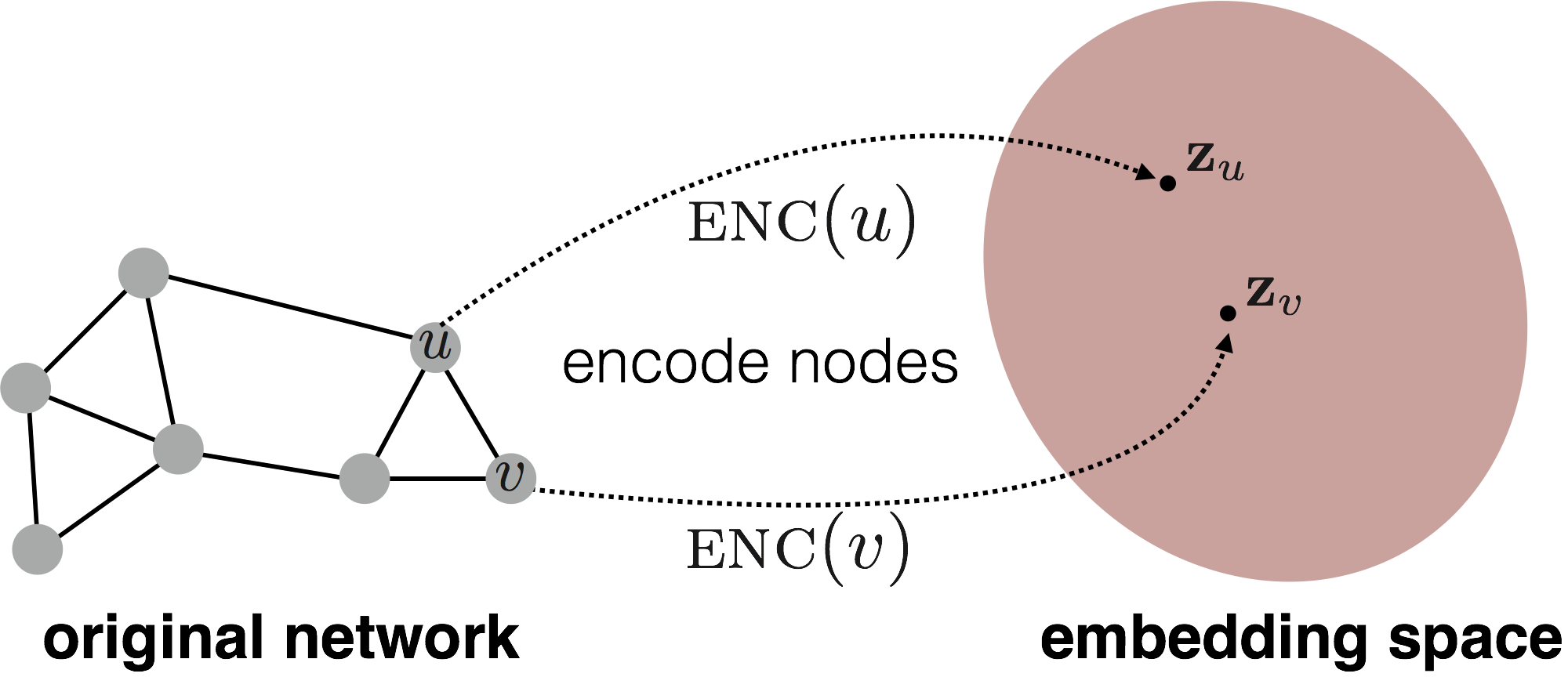
Embeddings encode nodes (and words)
An encoder ENC(·) maps each node (or word) to a point so that similarity in the embedding space
(e.g. a dot product zu·zv) approximates similarity in the context. High-dimensional features → a few semantic ones.
Exam material · Embeddings
What to revise: Embeddings
Concepts
Sparsity
Dense representations
Bag of words
Random walks
Embeddings table
Algorithms
Word2vec
Random-walk algorithms
Skills
Applying embeddings to supervised tasks
The role of context
Part II
Graph Mining
Graph properties, centrality and clustering — read through the lens of matrices and eigendecompositions.
Graphs as matrices
Matrix representations & graph properties
From adjacency matrix we read…distance between nodes · eccentricity (farthest reachable) ·
radius (min eccentricity) · diameter (max eccentricity) · centrality measures.
The adjacency matrix A is symmetric for an undirected graph; row sums give node degree, and powers Ak count walks of length k.
1
2
3
4
5
6
1
0
1
1
0
1
0
2
1
0
1
0
0
0
3
1
1
0
1
0
0
4
0
0
1
0
1
1
5
1
0
0
1
0
1
6
0
0
0
1
1
0
Graph partitioning · the Fiedler vector
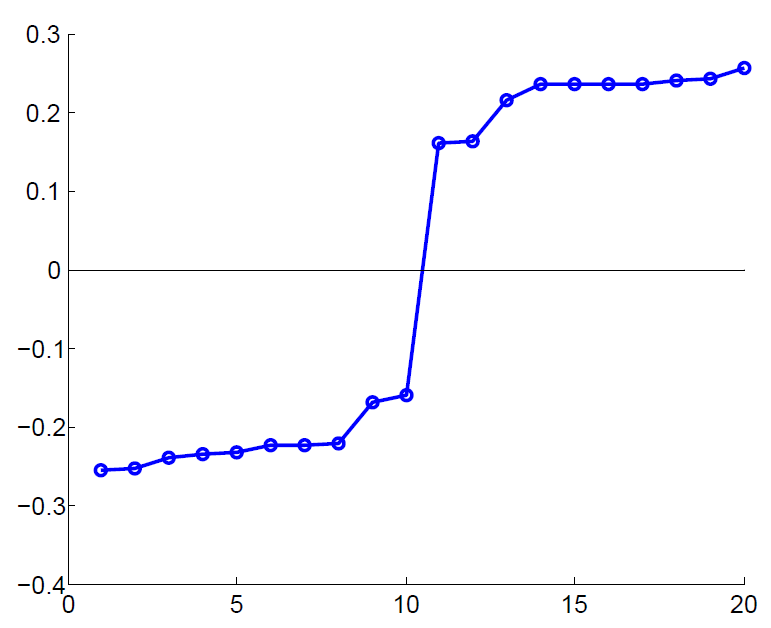
Spectral clustering: split by eigenvector sign
The second-smallest eigenvector of the Laplacian (the Fiedler vector). Sorting its entries, the sign of each component
assigns nodes to group A (negative) or B (positive) — a principled graph bisection.
Girvan–Newman · centrality computation
Community detection by edge betweenness
Give each edge a credit = the credit that flows from parent → child in a breadth-first tree.
Summed over all source nodes, this is the edge's betweenness — how many shortest paths run through it.
Remove the highest-betweenness edge, recompute, and repeat; the graph falls apart into communities.
Two routes to clusters
Spectral clustering cuts using the Laplacian's eigenvectors; Girvan–Newman cuts by repeatedly deleting high-credit edges. Both turn a graph into groups.
Exam material · Graph Mining
What to revise: Graph Mining
Concepts
Graph representation
Properties based on distances
Centrality measures
Laplacian
Eigendecompositions
Algorithms
Spectral clustering
Girvan–Newman algorithm
Skills
Applying spectral decomposition to clustering
Generalizing bisection to multiple clusters
Part III
Indexing Text
The data structures that let us search massive text collections fast — the inverted index and its dictionary.
The core structure
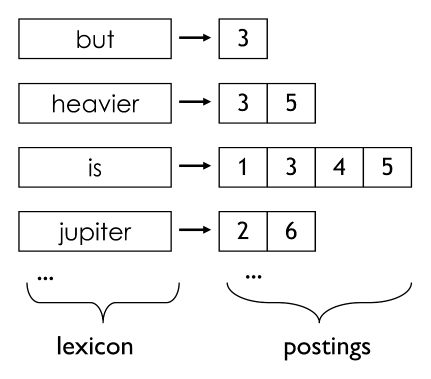
The inverted index
A lexicon (dictionary) of terms, each pointing to a postings list of the document IDs that contain it —
e.g. is → 1, 3, 4, 5. Answering a query = intersecting / merging postings lists.
Data structures for indexing
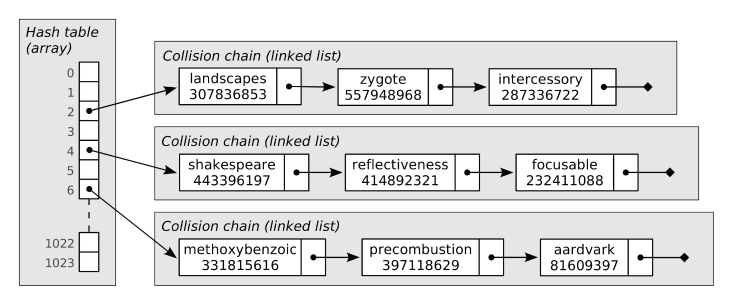
Dictionary lookup & the forward index
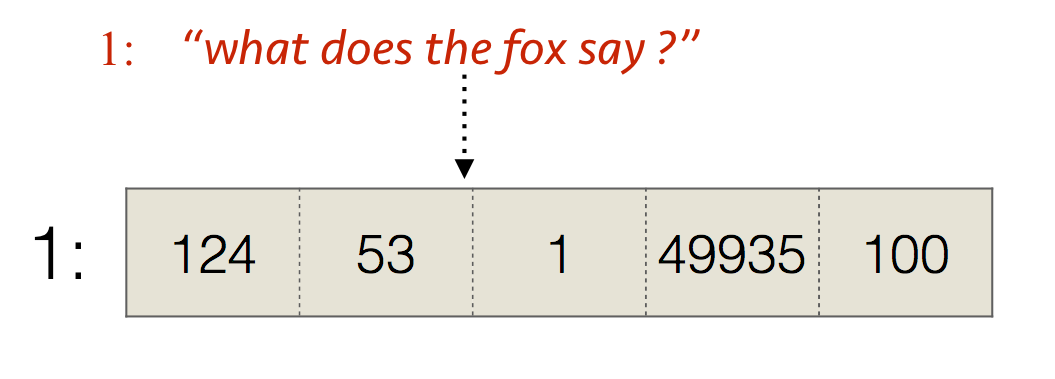
Left: the dictionary as a hash table with collision chains, mapping a term to its ID.
Right: a forward index — each document stored as its sequence of term IDs.
Exam material · Indexing Text
What to revise: Indexing Text
Concepts
Inverted indexes
Dictionary
Forward indexes
MapReduce
Algorithms
Query processing algorithms
Indexing algorithms
Skills
Dealing with large text collections
Dealing with query semantics
The spine of the whole course
Everything hangs off three verticals
Distances
Similarity & metrics
Embeddings for words & nodes
Context-based similarity
Matrices
Adjacency & Laplacian
Eigendecomposition / PCA
Graph mining & clustering
Counting
Hashing & sketching
Dictionaries & postings
Indexing text at scale
When a new exam question appears, first ask: is this fundamentally a distance, a matrix, or a counting problem?
How to prepare
Exam preparation checklist
For each topic, be able to…
State the concepts and why they matter, trace the algorithms by hand on a tiny example,
and apply the skill to an unseen problem.
Worked examples worth re-running: encode nodes with Word2vec / random walks,
bisect a graph with the Fiedler vector, delete edges with Girvan–Newman, and answer a query over an inverted index.
Closed book, calculator allowed · open and multiple-choice questions · no programming this year.
Only the selected chapters on Brightspace are examinable; the homework sets mirror exam type and difficulty.
Wrap-up · one slide
Summary
Take away
Embeddings turn raw data into dense, semantic vectors (unsupervised); graph mining reads
structure through matrices, the Laplacian and eigendecompositions; indexing makes massive text searchable with inverted and forward indexes.
All three sit on the course spine — Distances · Matrices · Counting. Revise each as
Concepts → Algorithms → Skills, and practise the worked examples by hand. Good luck on the exam.