%%{init: {"flowchart": {"htmlLabels": false, "nodeSpacing": 30, "rankSpacing": 40}, "theme": "base", "themeVariables": {"fontFamily": "Arial, Helvetica, sans-serif", "fontSize": "17px", "primaryTextColor": "#111111", "lineColor": "#555555"}}}%%
flowchart LR
  A[Applications<br/>chat · IDE · notebook · RAG · agents]
  B[API]
  P[External providers<br/>OpenAI · Anthropic · Google · OpenRouter]
  A --> B --> P
  style A fill:#F2F2F2,stroke:#555,color:#111
  style B fill:#FFFFFF,stroke:#555,color:#111
  style P fill:#F2F2F2,stroke:#555,color:#111
Local LLM Hosting at TU Delft
TULIP, Use Cases, and Next Steps
First alignment workshop
June 22, 2026
Why are we here?
Concrete questions we keep hearing on campus
“Can we have an endpoint that students can use in my lecture of 400 students for learning to code with LLMs?”
“Can we use LLM infra for annotating data in my research, because OpenAI is too expensive?”
“I don’t want to send resumes of PhD candidates to a commercial LLM — data privacy.”
The pattern
These aren’t asks for a chatbot. They are asks for shared, governed, affordable inference that an institution can stand behind.
Who are we?
REIT — Research Engineering & IT
A small team in REIT prototyping TULIP as institutional LLM serving for TU Delft.
Scan or visit → reit.tudelft.nl

Program
| Time | Session |
|---|---|
| 11:00–11:05 | Opening |
| 11:05–11:20 | Vision & what we’ve been building |
| 11:20–12:00 | Breakout 1: research and education use cases |
| 12:00–12:25 | Breakout 2: current tools, dependencies, and unmet needs |
| 12:25–12:35 | Grab food |
| 12:35–13:00 | Sharing, reflections & wrap-up |
What we want from today
Your concrete needs → our next-phase priorities.
LLMs are becoming infrastructure
Researchers and educators are already using LLMs through APIs
Common patterns today:
- chat interfaces
- coding assistants (Copilot, Cursor, Claude Code)
- RAG over internal documents
- agentic workflows
- research prototypes and educational tools
Most of these applications do not run models directly. They consume model endpoints provided by external services.
LLM serving ≠ LLM experimentation
Two different questions, two different infrastructures
| LLM experimentation | LLM serving |
|---|---|
| Fine-tuning models | Reliable inference |
| Benchmarking | Stable endpoints |
| Trying new architectures | Multi-user access |
| One researcher | Hundreds of users |
| GPU allocation | API management |
| Accuracy focus | Reliability focus |
The framing
- Research asks: can we build a better model?
- Serving asks: can hundreds of users reliably use a model?
Why universities need LLM serving — Accessibility
Shared access to AI capabilities
Where shared access matters
- students without paid subscriptions
- teaching at scale
- consistent model access across cohorts
- shared infrastructure for groups
- reproducible research environments
Concrete examples
- course assistants
- coding support in classrooms
- shared research prototypes
- student projects on stable endpoints
The accessibility argument
Today the quality of a student’s or researcher’s AI access often depends on whether they can pay for a personal subscription. A serving layer flattens this.
Why universities need LLM serving — Governance
Institutional control over AI usage
Where governance matters
- data remains within TU Delft
- GDPR compliance
- controlled access and authentication
- auditable usage
- reduced dependence on external providers
Concrete examples
- student assessments and feedback
- interviews and human-subject data
- internal and unpublished documents
- sensitive research data
The governance argument
Without institutional serving, sensitive workflows fall back to shadow IT (personal accounts on external APIs) or no AI at all.
Why universities need LLM serving — Institutional capability
Endpoints that outlive grants, subscriptions, and projects
Where capability matters
- universities increasingly build AI-powered systems
- RAG platforms over institutional content
- research software and pipelines
- educational tools
- agentic workflows
Concrete examples
- shared research tools
- durable educational infrastructure
- prototypes that survive personnel changes
- platforms used across departments
The strategic point
An LLM serving layer isn’t just a convenience for individual researchers — it is a piece of institutional infrastructure that the university needs to own, the same way it owns DAIC, NetID, or DelftBlue.
Our vision
A large-scale academic LLM serving platform for TU Delft
A platform that can support
- Research — annotation pipelines, experimentation, reproducibility
- Education — course-scale endpoints, classroom tools, student access at scale
- Data governance — sensitive data, GDPR, institutional control
Shaped by the institution, for the institution.
But today — we need your input
This workshop is to gauge your short-term needs so that we build from your requirements, not from our assumptions.
The deal:
- you tell us what you need;
- we build with those priorities;
- you have skin in the decisions that affect you.
Two breakout sessions are the mechanism.
What we want from you today
Concrete use cases, dependencies, and unmet needs → we turn them into the next phase of the platform.
What have we been cooking?
From conversations to a working prototype
March 2026 — workshop
Towards democratised academic LLM hosting
A cross-faculty conversation on what local LLM hosting should look like at TU Delft.
Since then
- gathered concrete use cases
- agreed on shared constraints: governance, access, integration
- aligned across REIT and ICT
Now — an experimental serving platform
We are building TULIP — TU Delft’s experimental LLM inference platform — as a working prototype of that idea.
The rest of this section is what TULIP is and where it stands today.
TULIP: current state and future directions
~11:15–11:20
What is TULIP?
TU Delft LLM Inference Platform
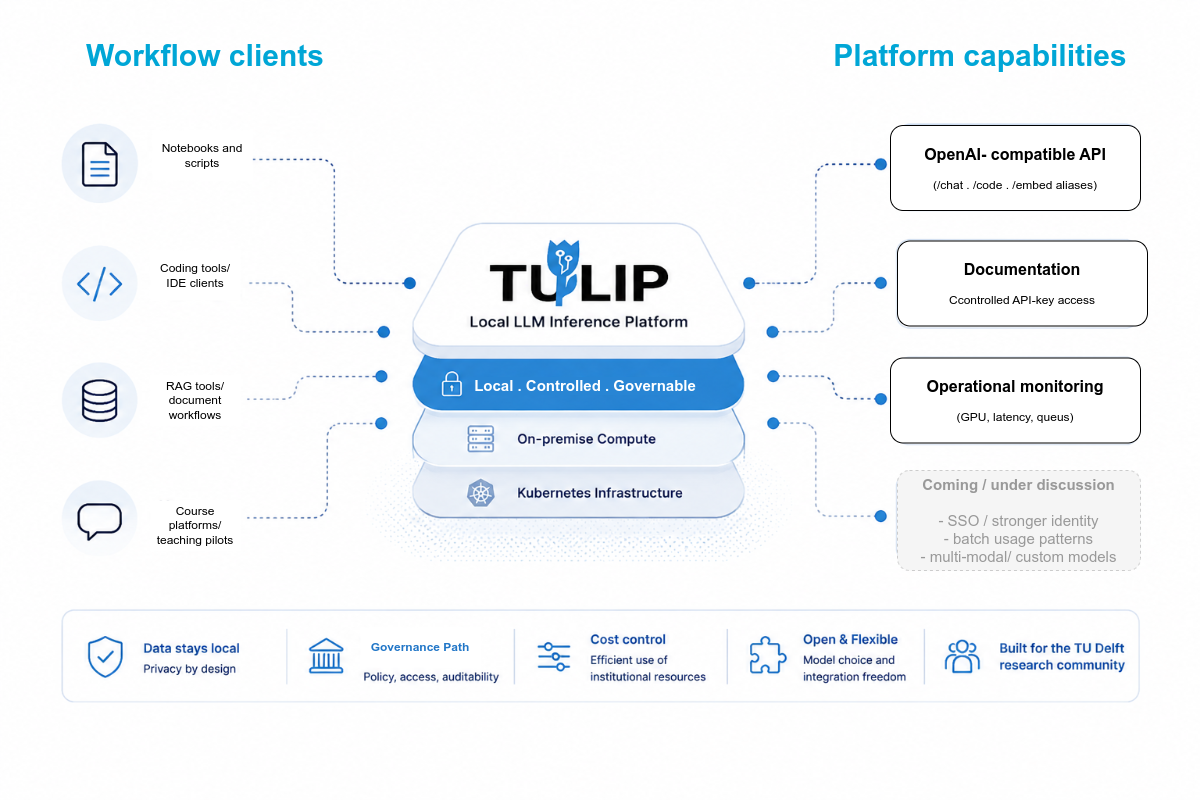
A REIT initiative, generously hosted by TU Delft ICT
What is available now?
| Capability | Current status |
|---|---|
| Models | Chat, code, embeddings |
| Access | Controlled pilot users |
| Interface | OpenAI-compatible API endpoints |
| Integration | Scripts, notebooks, IDE tools, compatible clients, and agentic workflows/tools |
| Operations | GPU, latency, queue, and service monitoring |
| Scale | Small platform: 1 server, 3× L40S GPUs |
Current status
TULIP is a controlled pilot-scale platform, not yet a full campus-wide production service.
With thanks to TU Delft ICT
The server node and L40S GPUs that TULIP runs on are generously hosted by TU Delft ICT. The platform exists because of their infrastructure support.
Example use patterns
| Use case | Example workflow | Implied requirements |
|---|---|---|
| Sensitive text analysis | Interviews, internal documents, unpublished material, assessments & feedback | Data locality and clearer governance |
| Education | Stable endpoints for courses and student projects | Predictability, fairness, no individual SaaS accounts |
| Coding workflows | IDE clients and coding-agent experiments | Institutional API, observability, cost visibility |
| RAG / retrieval | Embeddings over internal document collections | Reproducibility and local control |
| Research-support tools | Integration into platforms, demos, and prototypes | Shared infrastructure instead of fragmented deployments |
How we progress and what we aim for today
We aim to capture:
- your needs, expectations, and constraints;
- examples that are as specific and concrete as possible;
- where you see room for commitment, contribution, or collaboration.
Progression
We will move from use cases → current practice → priorities and collaboration.
Guided discussion: Research and Education Use Cases
11:20–12:00
Research and education use cases
- What LLM-based workflows are you using or planning?
- How could AI support coding, debugging, software design, feedback, scientific writing (grants, papers)?
- How could AI support tutoring, assessments, exercises, course design, feedback … etc?
Think of
- who the users/developers are;
- what model or capability is needed;
- what the soft and hard needs/requirements are, e.g. endpoint, tool, or support;
- whether the need is exploratory, near-term, or urgent.
Guided discussion: Current tools, dependencies, and unmet needs
12:00–12:25
Current tools, dependencies, and gaps
- What are you using? Copilot, Claude Code, Cursor, OpenRouter, Hugging Face Spaces, self-hosted models / collaborators’ APIs, something else?
- Are there paid external services or recurring API costs?
- What makes current workflows hard, risky, expensive, unsuitable, or difficult to support?
Think of
- which tools or services you actually rely on (paid or free);
- what data you send to them, and what data you would never send to them;
- which workflows are blocked, fragile, expensive, or hard to support;
- what would change in your work if those dependencies disappeared tomorrow.
Sharing and Reflections: Priorities and next steps
12:35–13:00
Group report-back
Briefly share:
- 1–2 concrete use cases;
- current tools or dependencies;
- main unmet needs or blockers;
- possible priorities, commitments, or collaborations.
After today
We will consolidate the notes into use cases, dependencies, unmet needs, and next steps for TULIP.
Next steps
What happens after today
1. Report & summarise
We consolidate what we heard today into:
- a use-case inventory
- common dependencies
- unmet needs and gaps
2. Widen the requirements net
Based on these findings, we:
- approach more groups across faculties
- collect broader requirements
- map them against TULIP’s roadmap
3. Follow-up workshop
When the demand picture is clearer, we hold a second workshop:
“What we want from you” — concrete asks back to you, scaled to the demand and needs we’ve heard.
The throughline
Today: your needs → soon: a wider scan → next: a shared plan.
Thank you!